
If your organisation has started measuring its carbon footprint, you’ve probably discovered an uncomfortable truth: Scope 3 emissions! The emissions generated across your value chain rather than from your own operations. These often account for the vast majority of your total impact. For manufacturers, retailers, and product-based businesses, these upstream and downstream emissions can represent 70% or more of their total emissions profile. The challenge is that Scope 3 is notoriously difficult to quantify, and even harder to reduce.
This is where Life Cycle Assessment (LCA) comes in.
What Is Life Cycle Assessment?
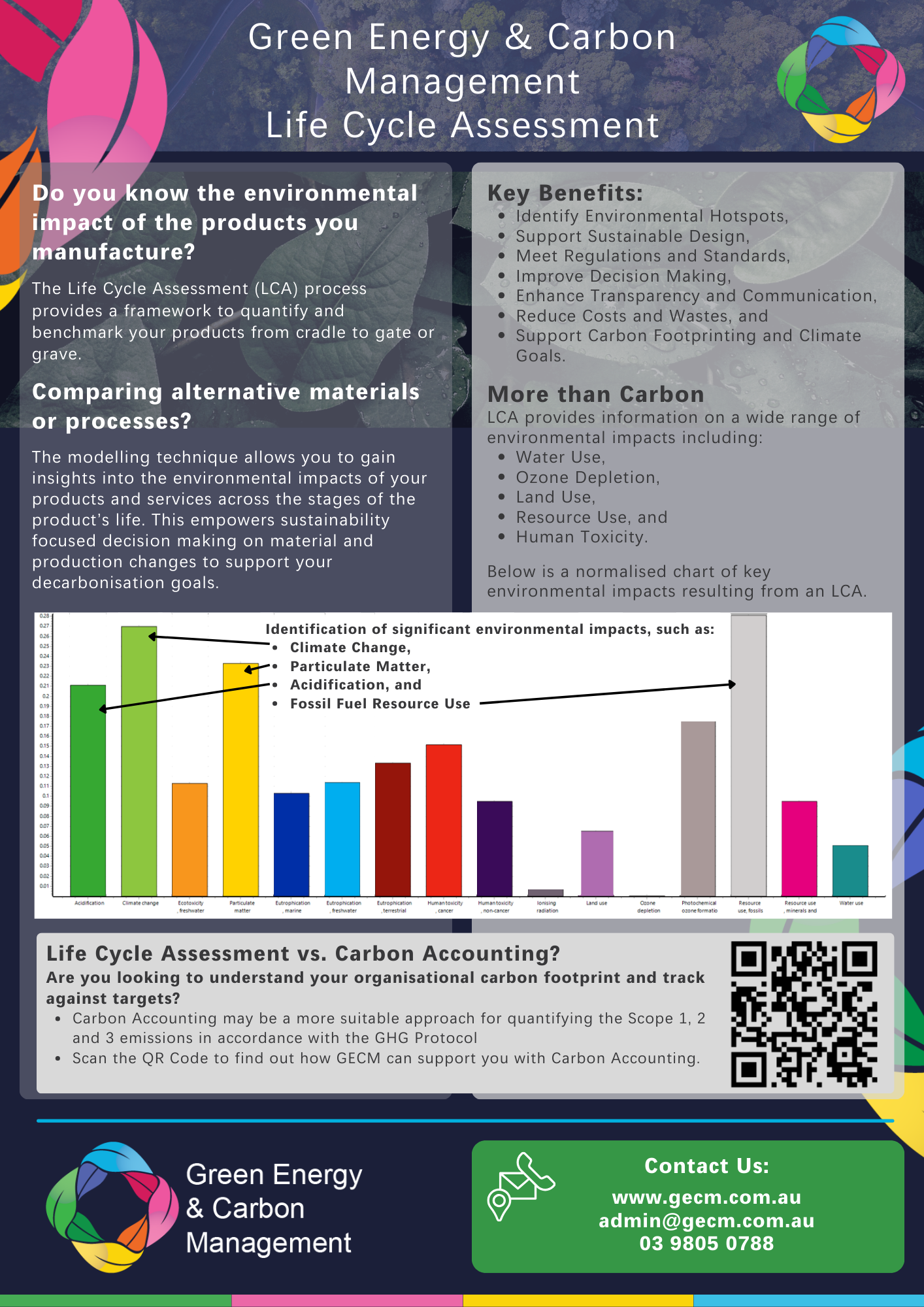
LCA is a systematic methodology for evaluating the environmental impacts of a product or service across its entire life, from raw material extraction through manufacturing, distribution, use, and eventual disposal or recycling. Often described as a “cradle to gate” or “cradle to grave” analysis, it provides a detailed, data-driven map of where environmental impacts actually occur.
Rather than relying on broad industry averages or rough estimates, LCA lets you pinpoint the specific stages, materials, and processes that contribute most to your footprint.
Beyond Carbon: A Fuller Picture of Environmental Impact
While carbon emissions rightly dominate the sustainability conversation, LCA captures a much wider range of environmental impacts. A thorough assessment also examines water use, ozone depletion, land use, resource consumption, human toxicity, acidification, and particulate matter generation, among others.
This matters because optimising for carbon alone can sometimes shift the burden to other impact categories. For example, a material substitution that lowers greenhouse gas emissions might significantly increase water consumption or ecotoxicity. LCA helps you see these trade-offs before committing to a change, enabling genuinely sustainable decision-making rather than a narrow focus that creates unintended consequences.
Why LCA Is Essential for Scope 3 Reduction
Carbon accounting frameworks like the GHG Protocol are excellent for tracking and reporting your organisation’s emissions against targets. But when it comes to actually reducing Scope 3 emissions, you need the granular, product-level insight that LCA provides.
In practice, LCA:
1. Helps you identify environmental hotspots, the specific materials, components, or supply chain stages responsible for the largest share of impact. This focus prevents you from investing time and resources in areas that will yield marginal improvements.
2. Empowers you to compare alternative materials or processes with confidence. LCA quantifies the real-world difference rather than relying on assumptions or marketing claims.
3. Supports product redesign by revealing which design choices carry the heaviest environmental burden, opening the door to innovation that reduces impact without compromising performance.
4. Strengthens your supply chain conversations. Armed with LCA data, you can engage suppliers with specific, evidence-based requests rather than vague appeals to “be more sustainable.”
Getting Started
If you’re already engaged in carbon accounting and reporting, LCA is a natural next step, moving you from measurement to action. The process does require quality data and specialist expertise, but the investment pays for itself through targeted emission reductions, cost savings from reduced waste and resource use, and stronger regulatory compliance as environmental standards tighten globally.
For organisations serious about decarbonisation, LCA transforms Scope 3 from an overwhelming reporting headache into a structured opportunity for meaningful improvement.
The question isn’t whether your products have environmental impacts — they do. The question is whether you understand where those impacts sit, and what you can do about them. Life Cycle Assessment gives you the answer.
If you’re ready to explore how LCA can help your organisation reduce its supply chain emissions and make smarter product decisions, get in touch with the team at Green Energy & Carbon Management. Visit www.gecm.com.au or email admin@gecm.com.au to start the conversation.
Lifecycle Assessment Factsheet